
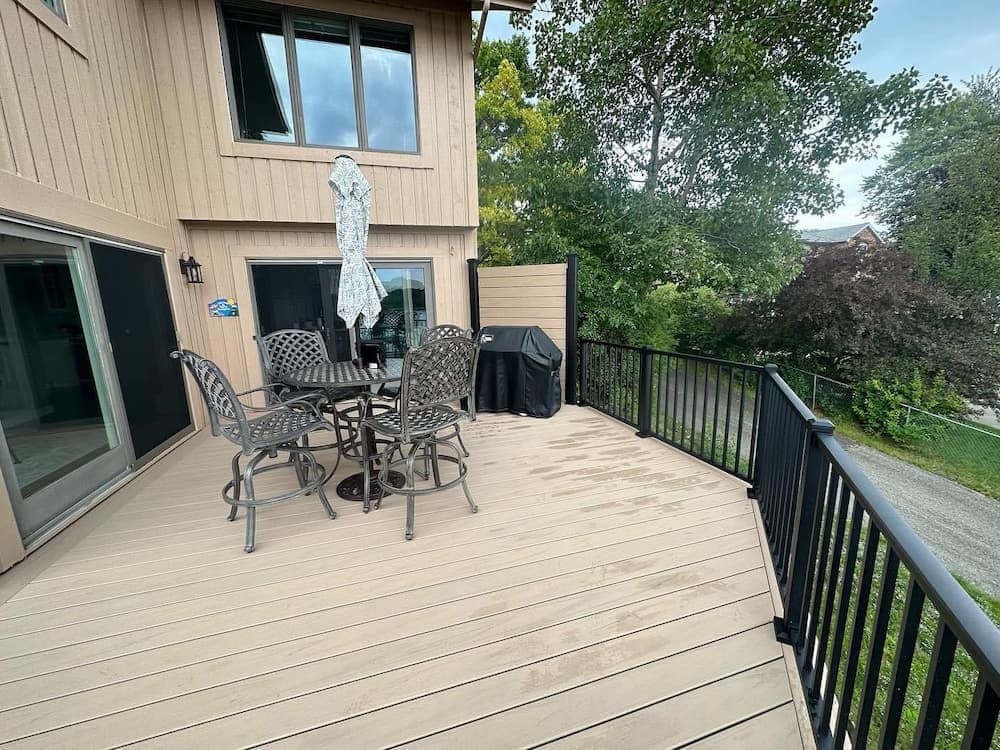
A new 16-by-20-foot deck averaged $25,023 with composite decking and $18,975 with wood decking in the Detroit market in the 2025 Cost vs. Value Report. That works out to roughly $78 per square foot for composite and $59 per square foot for wood. Height, stairs, railings, and site conditions can push your price above or below those averages.
Those numbers give you a realistic starting point for a professionally built deck in Commerce Township, Novi, Milford, Highland, Brighton, Howell, and the rest of Oakland and Livingston County. Below, we break down what goes into the cost of a custom composite or wood deck, where the money goes, and how to plan a deck budget that holds up.
Detroit-Area Deck Costs at a Glance
The Remodeling 2025 Cost vs. Value Report prices the same deck project in two materials. The project is a 320-square-foot deck with pressure-treated framing on concrete footings, a built-in bench and planter, stairs, and a railing system.
| Deck type (16 x 20 ft) | Detroit-area average job cost (2025) | Approx. cost per sq ft | Share of cost recouped at resale |
|---|---|---|---|
| Composite deck addition | $25,023 | About $78 | 73.8% |
| Wood deck addition | $18,975 | About $59 | 55.6% |
Cost per square foot is a helpful way to compare, but it isn't how decks are priced. Stairs, railings, footings, and permits cost about the same whether a deck is 200 or 400 square feet, so smaller decks usually cost more per square foot and larger, simpler decks usually cost less.
Planning a deck for next season? Request a free estimate and we'll measure the space, talk through materials, and put the full scope in writing.
What Drives the Cost of a New Deck
Decking material
The surface boards are the most visible choice and a major part of the budget. Pressure-treated lumber costs the least upfront. Cedar costs more and has a natural look. Composite decking, like Trex, costs more than wood upfront but doesn't need yearly staining or sealing. Within composite, each product line has a different price, look, and warranty. Our composite vs. wood decking guide compares the materials in detail.
Size and shape
Square and rectangular decks are the most efficient to frame. Angles, curves, multiple levels, and picture-frame borders add labor and material waste. A multi-level deck can be worth it on a sloped lot, but it costs more than a single platform of the same total area.
Height, stairs, and railings
A ground-level deck needs little or no railing. A deck off a second-floor walkout needs taller posts, more bracing, a longer staircase, and guards along every open edge. Railing is sold by the linear foot, and premium systems with aluminum balusters, glass panels, or cable can approach the cost of the decking itself.
Footings and site conditions
In Michigan, footings must extend below the frost depth set by the local building code so the deck doesn't heave during freeze-thaw cycles. Sloped yards, clay soil, tree roots, buried utilities, or limited access for equipment can add digging time and concrete. Your local building department confirms the required footing depth when the permit is reviewed.
Removing an old deck
Replacing an existing deck adds demolition and disposal. If the old footings or ledger connection don't meet current code, they are typically replaced as well. Our article on deck repair vs. replacement explains how to tell whether an old deck can be saved.
Permits and inspections
Most new decks need a building permit. Michigan's Building Permit Information page explains that the application goes to the enforcing agency for your property, which may be your city, township, county, or the state. Plan for permit fees, plan review time, and inspections. For a full walkthrough, read Do I Need a Permit to Build a Deck in Michigan?
Add-ons
Built-in benches, planters, privacy walls, pergolas, stair and post lighting, and skirting all add to the total. Many homeowners build the deck first and add features later, but wiring for lighting is easiest to plan before the decking goes down.
Composite vs. Wood: Which Costs Less Over Time?
Wood wins on upfront cost. Composite often closes the gap over the years because it doesn't need annual staining or sealing, and it isn't prone to rot, splintering, or insect damage the way wood boards are. A wood deck in Michigan usually needs cleaning and a fresh coat of stain or sealer every couple of years to hold up to snow, rain, and summer sun.
In the Detroit-area resale data, the composite deck recouped 73.8% of its cost compared with 55.6% for the wood deck. If you plan to stay in your home for many years and don't want weekend maintenance, composite is usually the better long-term value. If upfront budget matters most and you don't mind upkeep, wood is a solid choice.
How to Plan Your Deck Budget
- Decide how you'll use the deck. A grilling area, a dining table, and a lounge zone each need space. Sizing the deck around real use keeps you from paying for square footage you won't use.
- Choose the material early. Decking and railing choices change the price more than almost anything else.
- Ask what's included. Compare footings, framing, ledger work, decking, stairs, railings, permits, demolition, and cleanup line by line. Our guide on comparing remodeling estimates can help.
- Book early. Spring and summer are the busiest seasons for deck builders in Michigan. Planning in fall or winter gives time for design, permits, and material ordering before the season starts. See our deck installation timeline for what to expect.
Get a Deck Estimate From All American Remod
All American Remod is a family-owned company with more than 40 years of experience building composite and wood decks for homeowners across Oakland and Livingston County. We'll help you choose the right size, material, and railing for your home and budget, and our work is backed by our 18-month no-hassle warranty. Request your free, no-pressure estimate to get started.